
Our National Treasure
The Declaration of Independence is a beautiful document of intent by a people who were done with a tyrannical King, and ready to try governance of, by, and for the governed.

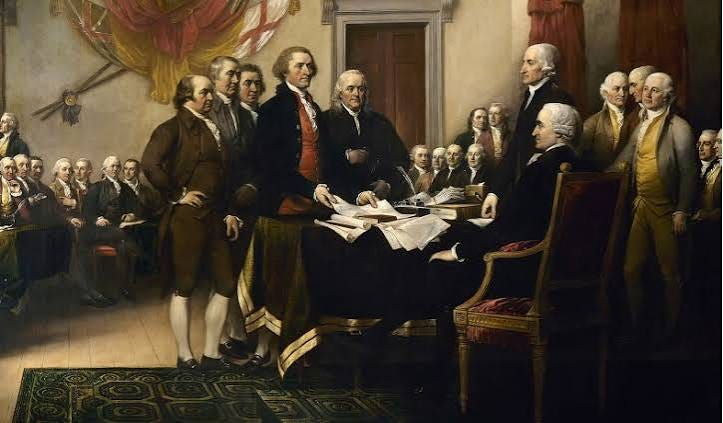
On July 4, 2026, we’ll celebrate the 250th anniversary of the Continental Congress officially adopting the Declaration of Independence. Though the actual document was signed about a month later by all 56 delegates on August 2, there are some historical and semantical inconsistencies regarding the July 4, 1776 date for signing.
Many historians posit John Hancock signed the original Dunlap Broadside, the first printed copy of the document on July 4, 1776. All agree that the actual parchment in the National Archives was signed by all of them from the 13 United States of America on that August 2, date.
Every year around this time I read it. Like many of the country’s founding documents, it’s not long, it’s very straightforward, and is easy to digest. If you haven’t read it for a long time - or - ever - pick it up. It’ll take you 15 minutes.
Because what we celebrate matters. Our history matters. And it’s part of a national history that too often is not taught or not taught well, except to immigrants seeking to pass the citizenship test. If I’m betting - I’ll wager at least half of the people born in the United States, (and probably way more than that) would struggle with a basic exam on US history and government. I’ll go you one better - I’m sure, given some of the rhetoric I’ve heard over the years - many in very high elected offices would struggle as well.
Quick - how many members in the House? It’s been the same for about 100 years… I’ll wait… yeah - that’s an easy one everyone gets right away.
The Declaration isn’t a governing document, right? You remember that one? While we’re on a short quiz - I know you know the first governing document of the United States? The Constitution, right? By the founding fathers who got the stone tablets from the mountain and so on.
NOPE.
The US Constitution was not our first governing document. The ineffectual and grim Articles of Confederation was, and it gave the states most of the power while creating a limp, one-branch federal government that - well - had no real path to govern.
Like not knowing or remembering The Declaration was actually signed by the delegates a month later than July 4, many forget or never knew about that rag, The Articles, that was in effect from 1781 to 1789 and the big problems it caused.
As we all remember…
After several spurts and false starts, they all finally get their shit together in Philadelphia and decide The Articles need severe amending. James Madison says in effect - oh give me the damned thing and I’ll bring a rewrite back. Once the anti-federalists take a look at his complete rewrite - they say - oh HELL no. There’s too much power in the hands of the federal government. We’ll ratify - but you gotta put in these 10 things - we’ll call em - anyone - Buehler?
Yes - The Bill of Rights - the first 10 Constitutional amendments. They get the 9 of the 13 states they need for ratification when New Hampshire puts pen to paper on June 21, 1788. And voila - we get a document nobody loves - but one that everyone can live with.
That’s the nature of these things, isn’t it?
But let’s go back to that first work on parchment from this budding new country - this, great experiment. The document was created to cut loose from the monarchy. The history of that means that God gives sovereignty to the King - and he rules (with his cabinet and advisors) with absolute authority. Church and State are linked.
We were like - yeah - no. Screw that. In fact, once we get to the creation of the big one - The Constitution - the very first amendment will include - God isn’t a part of this. The words “God”, “Christ” or “Christianity” do not appear in The Constitution, but everyone knows that.
So, the establishment clause becomes a big thing here - and thus - the first amendment text reads;
"Congress shall make no law respecting an establishment of religion, or prohibiting the free exercise thereof; or abridging the freedom of speech, or of the press; or the right of the people peaceably to assemble, and to petition the Government for a redress of grievances."
But first - we had to break ties. We had to tell King George III - fuck off. We’re gonna do it very differently here.
The Declaration then is a document reflecting and announcing to the world the intent of these United States to sever ties from the British Crown. That’s what we’re celebrating.
That’s what July 4 commemorates.
And here, just in time for the big 250!, I’ll go through The Declaration with you a bit - point out some things - and ask you earnestly to read it again with new eyes. I made US history, the Constitution, and American government a prime are of focus when finishing my college degree in 2016 and have authored several essays on these things over the years, and for some big publications.
And as you read it again - you may join me in thinking that someplace along the way - it’s pretty clear we’ve gone into a real ditch, and are lost along the side of the road, while not bothering to open the glove box, pull out the map, and see where we’re supposed to be going.
